
10 min read
Why streak apps stop working by week two
A habit streak pays you a little every day and charges you everything the day you miss. Why that flips around week two, and what to build instead.
Week one goes well. You do the thing, you tap the box, the number goes up. By day nine, the number is most of the reason you are opening the app at all.
That switch is the problem, and it is built into the counter rather than into you. A habit streak pays a tiny reward every day and charges the entire balance the first day you miss. Early on that is a fine deal, because you have nothing to lose. By the second week you have something to lose, and the app you downloaded to encourage you has quietly started threatening you instead.
What follows is an argument about the mechanism, not a claim about how many people quit. Here is what a streak actually is, when it turns, and what to use in its place.
What a streak actually is
Take away the flames, the confetti and the leaderboards and a streak is two rules:
- Do the thing today and a number goes up by one.
- Miss one day and the number goes to zero.
Those rules are not symmetrical, and the asymmetry is the entire design. The reward is small, fixed and daily. The penalty is the whole balance, charged at once, with no partial credit. Almost nothing else in your life is scored this way. A savings account does not empty itself because you skipped a deposit.
So a streak is a deposit you can never withdraw and can only lose. While the balance is small, the app feels generous. Once the balance is large, the app is holding something of yours.
The day a streak switches sides
Somewhere in the second week, the question changes. It stops being “do I want to read tonight” and becomes “am I going to lose my streak”. Those are different questions with different answers, and only one of them has anything to do with reading.
There is a well documented reason the second question is louder: Kahneman and Tversky’s prospect theory is built on the finding that losses weigh more heavily than gains of the same size.
You can watch the switch happen in your own behavior. The tell is the token rep: the two minute lesson at 11:52 PM, the single page, the box ticked for a walk to the kitchen. The counter cannot tell that apart from a real day, because the counter was never measuring the behavior. It measures compliance with itself.
That is also why a long streak can sit on top of a habit that has quietly stopped happening. The number says 47. The thing you wanted says three real sessions this month and a lot of 11:52 PM.
Why week two
Week two is where two curves cross.
The novelty has run out. Week one is partly powered by a new app, a fresh screen and the pleasure of setting something up. None of that is left by day ten, and what remains is the behavior itself, on a Tuesday, when you are tired.
The number has become worth defending. It is now large enough that losing it would sting, which means every day carries a small tax of anxiety that was not there on day two. The app is no longer offering you a win. It is asking you to avoid a loss, over and over.
And the first unavoidable miss usually lands right here. A ten day run has to survive one late night, one trip, one illness, one day that simply got away from you. Two weeks is long enough for real life to show up at least once.
What happens when it breaks
Zero. Not eleven and a note about eleven. Zero, on the same screen you saw on day one, as though the eleven days had not happened.
The reasonable response is to shrug and start again tomorrow. Two things get in the way.
The first is the accounting. It is genuinely hard to look at a zero and feel you kept anything, even though you know you did eleven days. The second is that the collapse tends to be bigger than the lapse. Researchers call this the what the hell effect, after Cochran and Tesser’s work on goal proximity and goal framing: one violation of a goal is often followed by abandoning it rather than resuming it. A streak makes that easier, because it has already declared the whole project void on your behalf.
The evidence says the accounting is wrong. In one real world study of habit formation, Lally and colleagues followed 96 people performing a daily behavior for 12 weeks and reported that “missing one opportunity to perform the behaviour did not materially affect the habit formation process” (European Journal of Social Psychology, 2010). The same study found the time taken to reach 95 percent of a person’s automaticity plateau ranged from 18 to 254 days.
Read those two findings together. Habit formation is slow, wildly variable between people, and barely dented by one missed day. A streak counter is fast, identical for everyone, and total about one missed day. It is not modeling the thing it claims to measure.
The apps know it, too. Even the streak most people would name first ships an official exception to its own rule: Duolingo’s Streak Freeze holds your count through a day you miss. A rule that needs a documented escape hatch was doing more than its designers wanted.
What to do instead
None of this means tracking is bad. It means the counter should not be the consequence. Four changes, and you can make all of them today with whatever you already use.
Make the consequence immediate and daily
A streak’s consequence is deferred and cumulative: nothing happens today, and then everything happens on the day you break. Flip both. The consequence you want is small, immediate and expires tonight. If the habit is not done, something you want is not available yet. When it is done, it is available.
That is the shape of habit gated blocking: the apps that eat your evening stay shut until today’s habits are marked done, then open. The lock is enforced by iOS rather than by the app that set it, which is why it holds even when the app is closed. We covered the machinery in how Screen Time app blocking really works on iPhone, and the four ways to set up a conditional unlock in how to block apps on iPhone until your tasks are done.
Note what this does at the end of the day. Nothing carries over. You cannot build up a balance, so there is nothing to lose tomorrow.
Keep the unit small enough for your worst day
Pick the version of the habit you would still do on a bad Tuesday: ten pages, not fifty. Ten minutes, not an hour. Good days can overshoot, and they will.
A streak pushes you the other way and then back again. At the start you set an ambitious daily target because you are excited. Later, once the number is big, you protect it with the smallest token that will register. Neither size was chosen for the habit.
Let a missed day cost exactly one day
Keep two numbers instead of one: days done this month, and your longest run ever. Miss a day and the first number simply stops for a day. It does not reverse, and the second number is a record rather than a hostage.
This needs no software at all. A wall calendar and a pen do it. The point is not the tool, it is that the ledger is additive: you are collecting days rather than defending a tower.
Put the message where the temptation is
A number on a home screen is not present at 10 PM. What is present at 10 PM is the app you are about to open. A reminder that fires at 8 AM asks a person who is not tempted yet, and by the time you are tempted the reminder is fourteen hours old and swiped away. This is the real gap between a tracker and a blocker, and it is worth a whole comparison of its own: habit tracker or app blocker.
Habit Hound is ours, so read this paragraph accordingly. It is a habit app with no streak guilt: no notifications, no reminders, no evening ping asking why you have not meditated. The apps you choose stay locked until you mark today’s habits done, and the lock comes back tomorrow. You mark them yourself; the app does not check up on you or watch what you do elsewhere on the phone.
The Progress calendar does show Active Days, Perfect Days and a best streak, because watching the days add up is genuinely satisfying. What it does not do is let any of that touch the lock. Break a run and tomorrow’s deal is the deal you had before: finish today’s habits, get today’s apps.
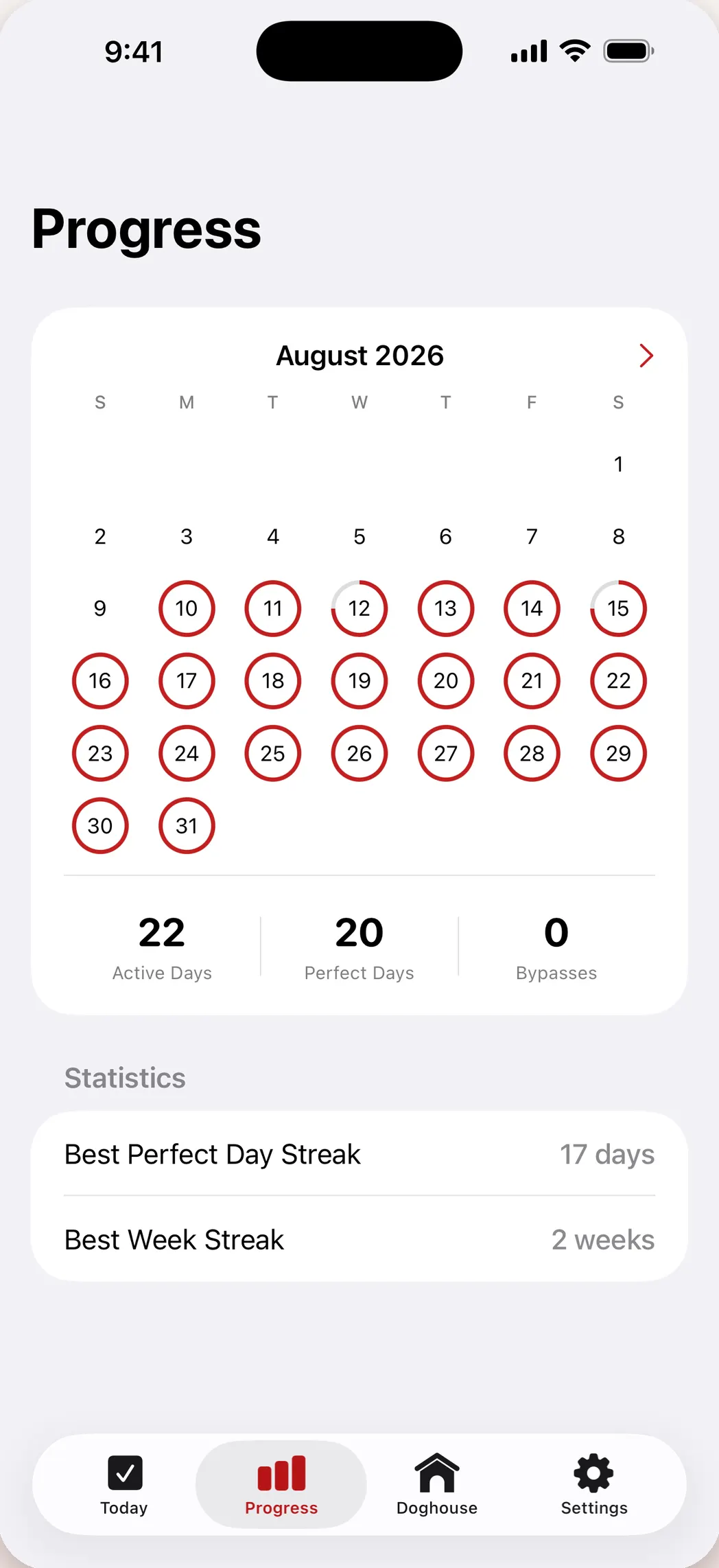
We are not pretending we solved this. A best streak on a calendar can still be a thing you dread losing. The difference we can defend is narrow and worth stating plainly: nothing in the app punishes you for the zero, and nothing about tomorrow gets harder because yesterday went badly.
If your streak is working, keep it
Some people genuinely run on the number, do not wobble at day ten, and restart at one without drama. External structure suits some people more than others, and a counter that carries you is a counter worth keeping. Nothing above is an argument for deleting a tracker you like.
The test is what happened last time yours broke. If you started again the next day, the streak is a record, and records are good. If you stopped opening the app entirely, it was a threat, and it worked exactly once.
Questions people ask
Why do I lose motivation about two weeks into a habit tracker?
Two things arrive at the same time. The novelty of a new app is gone by then, so the behavior has to stand on its own, and the streak has grown big enough that every day is now about not losing it rather than about doing it. On top of that, the first genuinely difficult day tends to land inside the first fortnight, and a streak has no way to absorb one.
Does breaking a streak mean I have to start the habit over?
No. Lally and colleagues found that “missing one opportunity to perform the behaviour did not materially affect the habit formation process” (European Journal of Social Psychology, 2010). The counter resets to zero because that is the rule the counter was given. The habit does not.
Are streak freezes and repairs cheating?
No, and using one is fine. Just notice what the feature tells you: if an app has to build protection against its own penalty, the penalty was the problem. You can get the same forgiveness for free by counting days done this month instead of consecutive days.
What should I track instead of a streak?
Track days done in the current month, and keep your longest run as a record rather than a live balance. Then attach a consequence that resets every day, so a bad day costs one day and nothing more. That can be as simple as a rule you keep, or an app that keeps it for you.
Do habit apps that block apps use streaks too?
Some do and some do not, and it is worth checking before you install. The question to ask is whether the block gets harder or easier based on your history. If yesterday changes what today costs, you have a streak with a lock attached. If every day starts the same, you have a daily deal.